
01Walk the space
Point the phone and walk. On a LiDAR iPhone, Apple RoomPlan measures walls, doors and equipment in metres.
Yes: with Airsup you walk the line with an iPhone and get a runnable digital twin of it. The Airsup app measures the room, finds the machines and stations, reads their nameplates and opens a simulation of the line within minutes.

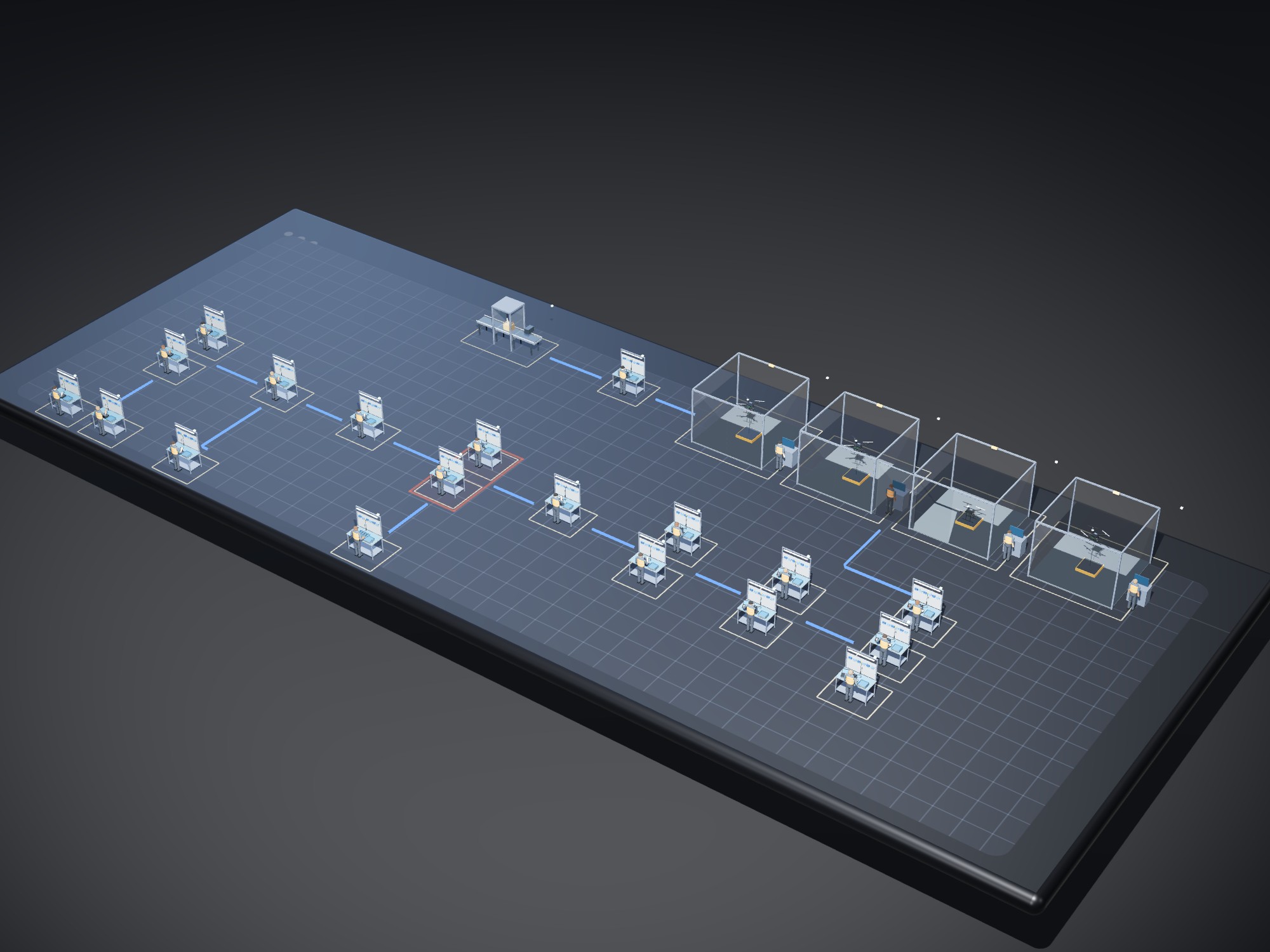
Capture on the left, the twin it becomes on the right. Illustrative footage and line.
Scan, twin, simulation and agents, in one workspace.
Point the phone and walk. On a LiDAR iPhone, Apple RoomPlan measures walls, doors and equipment in metres.
The detector names machines, workstations, conveyors, racks and test stations, and reads nameplates so a HAAS plate becomes a CNC mill.
Routing, cycle times, buffers and operators are written into a plan, each assumption with its source and confidence.
A seeded discrete event simulation runs the plan. The twin opens in your workspace, on the laptop and on the phone.
An iPhone. A LiDAR iPhone (Pro models) measures the room in metres; other models still capture the machines and the flow.
Our team comes in and scans the facility, or your team scans it with the Airsup app.
It places every station and measures the space. Cycle times come from the camera, the maker, your data or an assumption, and the twin shows which one for every number.